




The package is ready. Your customer is waiting. Now comes the moment that defines their entire experience with your brand: the final journey from warehouse to doorstep.
In this guide, you'll discover what last-mile delivery really means, why it matters for your bottom line, and five actionable strategies to optimize it. You’ll also see how a multi-carrier shipping platform like Swotzy can simplify the entire process, helping you save time, cut costs, and deliver a smoother customer experience.
Let’s dive in.
Last-mile delivery is the final stage of the shipping process, when a product is transported from a fulfillment center, warehouse, or distribution hub to the customer’s chosen destination.
This destination could be:
Despite its name, the “last mile” can cover distances from just a few blocks to over 50 miles, depending on the seller’s fulfillment network and the customer’s location.
Your customer doesn't see your warehouse operations, inventory management, or long-haul trucking. They only experience the last mile—the tracking updates, the delivery window, the condition of the package when it arrives.
This final touchpoint carries outsized weight, shaping everything from perception to profitability:
Get last-mile delivery right, and it becomes a powerful differentiator that builds trust and loyalty. Get it wrong, and even the best product won’t protect you from negative reviews and lost customers.
Exceptional last-mile delivery is about doing it reliably, cost-effectively, and in a way that delights customers.Master any of these five characteristics, and you'll take a huge step towards turning your biggest expense into your strongest competitive advantage.
The distance between your inventory and your customers directly impacts delivery speed, shipping costs, and your carbon footprint.
When your products are stored closer to your customer base, you can:
And it lets you offer fast shipping options like same-day or next-day delivery, which are increasingly popular among shoppers.The data backs this up: two-thirds of global shoppers expect orders within 24 hours. Without strategic inventory placement, meeting these expectations becomes impossible or prohibitively expensive.
How to optimize::
For growing businesses: partner with a 3PL provider that operates multiple fulfillment centers across your key markets. This lets you distribute inventory strategically without the overhead of managing multiple warehouses.
For established businesses: analyze your order data to identify geographic clusters of customers, then establish regional fulfillment centers in those areas. Even 2-3 strategically placed warehouses can dramatically reduce average delivery times.
For all businesses: use a multi-carrier shipping platform like Swotzy to automatically route orders to the nearest fulfillment point and select the most cost-effective carrier for each destination.
Uncertainty breeds anxiety. When customers don't know where their package is or when it'll arrive, they worry, and worried customers contact support, leave negative reviews, or simply not buy again.
Clear communication is crucial for the long-term success of your business because it:
Keeping customers informed about their order status and expected delivery time allows for better coordination and ensures a more positive overall experience.
💡Pro tip: Use SMS for time-sensitive updates (out for delivery, delivered) and email for detailed information. Always include accurate delivery windows, because vague estimates like "3–5 business days" create more anxiety than they solve.
Here’s an nteresting fact: This McKinsey study found that while consumers are excited about same-day delivery, they’re even more enthusiastic about precise delivery tracking. In fact, reliability often matters more to them than sheer delivery speed.
When you provide comprehensive tracking, you:
Research from Verte revealed that 91% of shoppers actively check their packages. 19% even check multiple times a day.If you work with multiple carriers (DHL, UPS, FedEx, regional carriers), tracking becomes fragmented. Customers have to check different websites with different tracking number formats.
Customer needs vary dramatically. Some want the cheapest option and will wait a week. Others need it tomorrow and will pay premium prices. Some are never home during the day. Others want to pick up packages on their schedule.
The more delivery options you offer, the more customers you can serve and the better you can handle unexpected challenges.
The 3 main benefits of a reliable and versatile delivery partner network:
How to optimize:
We integrate with popular carriers, including USPS, UPS, FedEx, DHL, and regional specialists. For every shipment, our platform.
According to Baynard Institute’s research, unclear return policies make up 15% of shoppers who abandon their carts.
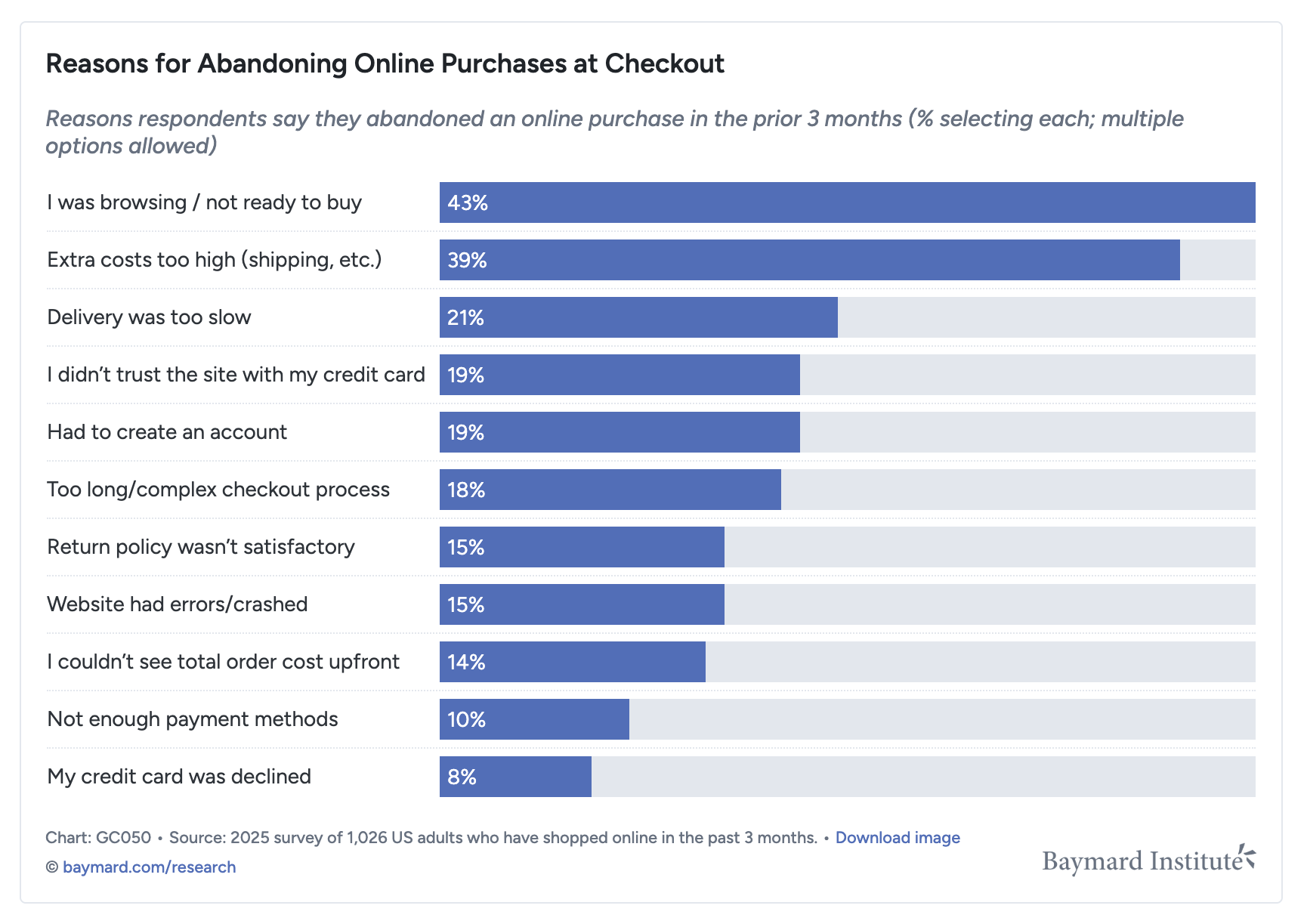
So, developing a clear, user-friendly returns and exchange policy is paramount.
1. Create a clear, customer-friendly return policy
Your policy should answer:
Be transparent and make this information easy to find before purchase.
2. Offer multiple return methods
Different customers prefer different return methods:
3. Optimize return shipping costs
Return shipping can destroy your margins. Strategies to reduce costs:
4. Process returns quickly
Speed matters:
5. Learn from returns data
Track return reasons to identify:
The goal here is to take returns easy for customers while protecting your margins.
Last year, the global last-mile delivery market was worth $179.5B. To put it into perspective, that’s around the same as the GDPs of Iceland, Costa Rica, and Latvia combined.
E-commerce is the second-largest category of last-mile delivery services, right behind food delivery.
So, it’s safe to say that the last-mile delivery user base is huge. It’s often used by e-commerce store owners who want their products delivered faster and cheaper without sacrificing customer trust and satisfaction.
Local courier services cater to delivery needs within a specific region or city. They’re ideal for fast, on-demand, or same-day deliveries and are often favored by businesses that prioritize speed and flexibility.
Downside: Their coverage area is limited, and costs can rise quickly as order volumes grow.
Third-party logistics (3PL) providers handle a wide range of logistics operations — from warehousing and order fulfillment to transportation. They’re a great option for scaling businesses that want to outsource complex logistics tasks.
Downside: Choosing the right partner requires careful research, and service fees can add up over time.
Postal services remain a trusted choice for sending smaller parcels, both nationally and internationally. They’re reliable and often integrate easily with eCommerce platforms.
Downside: Delivery times tend to be slower, and tracking visibility can be limited compared to private carriers.
To truly optimize your delivery process, consider using last-mile delivery software or shipping management platforms. These tools enable you to compare carriers, automate label creation, and track deliveries in real time – helping you balance speed, cost, and customer satisfaction across all your shipping options.
Traditional shipping is broken. You're stuck juggling multiple carrier accounts, manually comparing rates, dealing with fragmented tracking systems, and hoping you made the right choice for each shipment.
Swotzy is the modern alternative built for e-commerce businesses that want enterprise-level logistics without the complexity.
Swotzy’s multi-carrier platform gives you:
Sign up for Swotzy for free and compare rates for your actual destinations and package sizes. See exactly how much you could save.
No credit card required. You only pay for shipments you send out for lower rates.
The package is ready. Your customer is waiting. Now comes the moment that defines their entire experience with your brand: the final journey from warehouse to doorstep.
In this guide, you'll discover what last-mile delivery really means, why it matters for your bottom line, and five actionable strategies to optimize it. You’ll also see how a multi-carrier shipping platform like Swotzy can simplify the entire process, helping you save time, cut costs, and deliver a smoother customer experience.
Let’s dive in.
Last-mile delivery is the final stage of the shipping process, when a product is transported from a fulfillment center, warehouse, or distribution hub to the customer’s chosen destination.
This destination could be:
Despite its name, the “last mile” can cover distances from just a few blocks to over 50 miles, depending on the seller’s fulfillment network and the customer’s location.
Your customer doesn't see your warehouse operations, inventory management, or long-haul trucking. They only experience the last mile—the tracking updates, the delivery window, the condition of the package when it arrives.
This final touchpoint carries outsized weight, shaping everything from perception to profitability:
Get last-mile delivery right, and it becomes a powerful differentiator that builds trust and loyalty. Get it wrong, and even the best product won’t protect you from negative reviews and lost customers.
Exceptional last-mile delivery is about doing it reliably, cost-effectively, and in a way that delights customers.Master any of these five characteristics, and you'll take a huge step towards turning your biggest expense into your strongest competitive advantage.
The distance between your inventory and your customers directly impacts delivery speed, shipping costs, and your carbon footprint.
When your products are stored closer to your customer base, you can:
And it lets you offer fast shipping options like same-day or next-day delivery, which are increasingly popular among shoppers.The data backs this up: two-thirds of global shoppers expect orders within 24 hours. Without strategic inventory placement, meeting these expectations becomes impossible or prohibitively expensive.
How to optimize::
For growing businesses: partner with a 3PL provider that operates multiple fulfillment centers across your key markets. This lets you distribute inventory strategically without the overhead of managing multiple warehouses.
For established businesses: analyze your order data to identify geographic clusters of customers, then establish regional fulfillment centers in those areas. Even 2-3 strategically placed warehouses can dramatically reduce average delivery times.
For all businesses: use a multi-carrier shipping platform like Swotzy to automatically route orders to the nearest fulfillment point and select the most cost-effective carrier for each destination.
Uncertainty breeds anxiety. When customers don't know where their package is or when it'll arrive, they worry, and worried customers contact support, leave negative reviews, or simply not buy again.
Clear communication is crucial for the long-term success of your business because it:
Keeping customers informed about their order status and expected delivery time allows for better coordination and ensures a more positive overall experience.
💡Pro tip: Use SMS for time-sensitive updates (out for delivery, delivered) and email for detailed information. Always include accurate delivery windows, because vague estimates like "3–5 business days" create more anxiety than they solve.
Here’s an nteresting fact: This McKinsey study found that while consumers are excited about same-day delivery, they’re even more enthusiastic about precise delivery tracking. In fact, reliability often matters more to them than sheer delivery speed.
When you provide comprehensive tracking, you:
Research from Verte revealed that 91% of shoppers actively check their packages. 19% even check multiple times a day.If you work with multiple carriers (DHL, UPS, FedEx, regional carriers), tracking becomes fragmented. Customers have to check different websites with different tracking number formats.
Customer needs vary dramatically. Some want the cheapest option and will wait a week. Others need it tomorrow and will pay premium prices. Some are never home during the day. Others want to pick up packages on their schedule.
The more delivery options you offer, the more customers you can serve and the better you can handle unexpected challenges.
The 3 main benefits of a reliable and versatile delivery partner network:
How to optimize:
We integrate with popular carriers, including USPS, UPS, FedEx, DHL, and regional specialists. For every shipment, our platform.
According to Baynard Institute’s research, unclear return policies make up 15% of shoppers who abandon their carts.
So, developing a clear, user-friendly returns and exchange policy is paramount.
1. Create a clear, customer-friendly return policy
Your policy should answer:
Be transparent and make this information easy to find before purchase.
2. Offer multiple return methods
Different customers prefer different return methods:
3. Optimize return shipping costs
Return shipping can destroy your margins. Strategies to reduce costs:
4. Process returns quickly
Speed matters:
5. Learn from returns data
Track return reasons to identify:
The goal here is to take returns easy for customers while protecting your margins.
Last year, the global last-mile delivery market was worth $179.5B. To put it into perspective, that’s around the same as the GDPs of Iceland, Costa Rica, and Latvia combined.
E-commerce is the second-largest category of last-mile delivery services, right behind food delivery.
So, it’s safe to say that the last-mile delivery user base is huge. It’s often used by e-commerce store owners who want their products delivered faster and cheaper without sacrificing customer trust and satisfaction.
Local courier services cater to delivery needs within a specific region or city. They’re ideal for fast, on-demand, or same-day deliveries and are often favored by businesses that prioritize speed and flexibility.
Downside: Their coverage area is limited, and costs can rise quickly as order volumes grow.
Third-party logistics (3PL) providers handle a wide range of logistics operations — from warehousing and order fulfillment to transportation. They’re a great option for scaling businesses that want to outsource complex logistics tasks.
Downside: Choosing the right partner requires careful research, and service fees can add up over time.
Postal services remain a trusted choice for sending smaller parcels, both nationally and internationally. They’re reliable and often integrate easily with eCommerce platforms.
Downside: Delivery times tend to be slower, and tracking visibility can be limited compared to private carriers.
To truly optimize your delivery process, consider using last-mile delivery software or shipping management platforms. These tools enable you to compare carriers, automate label creation, and track deliveries in real time – helping you balance speed, cost, and customer satisfaction across all your shipping options.
Traditional shipping is broken. You're stuck juggling multiple carrier accounts, manually comparing rates, dealing with fragmented tracking systems, and hoping you made the right choice for each shipment.
Swotzy is the modern alternative built for e-commerce businesses that want enterprise-level logistics without the complexity.
Swotzy’s multi-carrier platform gives you:
Sign up for Swotzy for free and compare rates for your actual destinations and package sizes. See exactly how much you could save.
No credit card required. You only pay for shipments you send out for lower rates.